



Ice Cream » Ice Cream Varieties » Frozen Ice Cream
Frozen Ice Cream
Once upon a time, hundreds of years ago, Charles I of England hosted a sumptuous state banquet for many of his friends and family. The meal, consisting of many delicacies of the day, had been simply superb but the "coup de grace" was yet to come. After much preparation, the King's French chef had concocted an apparently new dish.
It was cold and resembled fresh-fallen snow but was much creamier and sweeter than any other after-dinner dessert. The guests were delighted, as was Charles, who summoned the cook and asked him not to divulge the ice cream recipe for his frozen cream.
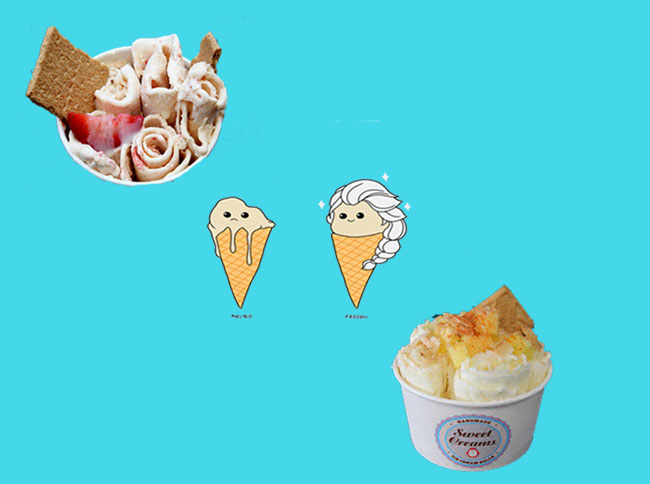
The King wanted the delicacy to be served only at the Royal table and offered the cook 500 pounds a year to keep it that way. Sometime later, however, poor Charles fell into disfavor with his people and was beheaded in 1649. But by that time, the secret of the frozen cream remained a secret no more. The cook, named DeMirco, had not kept his promise.
It is likely that ice cream was not invented, but rather came to be over years of similar efforts. The Roman Emperor Nero Claudius Caesar is said to have sent slaves to the mountains to bring snow and ice to cool and freeze the fruit drinks he was so fond of. Centuries later, the Italian Marco Polo returned from his famous journey to the Far East with a recipe for making water ices resembling modern day sherbets.
In 1773, a caterer named Phillip Lenz announced in a New York
newspaper that he had just arrived from London and would be
offering for sale various confections, including ice
cream . Mrs. Dolly Madison, wife of U.S. President
James Madison. also served ice cream at her husband's Inaugural
Ball in 1813.
The first improvement in the manufacture of Frozen ice cream (from the handmade way in a large bowl) was by a New Jersey woman, Nancy Johnson, who in 1845 invented the hand-cranked freezer.
This device is still familiar to many. By turning the freezer handle, they agitated a container of ice cream mix in a bed of salt and ice until the mix was frozen. Because Nancy Johnson lacked the foresight to have her invention patented, her name ice cream recipes does not appear on the patent records. A similar type of freezer was, however, patented on May 29, 1849, by a Mr. Young who at least had the courtesy to call it the "Johnson Patent Ice Cream Freezer".
Commercial production was begun in North America in Baltimore, Maryland, 1850, by Mr. Jacob Fusel, now known as the father of the American ice cream industry.
About 1926 the first commercially-successful continuous process freezer was perfected. The continuous freezer, developed by Clarence Vogt, and later ones produced by other manufacturers, has allowed the ice cream industry to become a mass producer of its product.
The first Canadian to start selling ice cream was Thomas Webb of Toronto, a confectioner, around 1851. William Neilson produced his first commercial batch of ice cream on Gladstone Ave. in Toronto in 1892, and his company produced ice cream at that location for close to 200 years.